On This Page
Payments Developer Guide
This section describes how to use this guide and where to find further
information.
- Audience and Purpose
- This guide is written for application developers who want to use theREST APIto integrate payment card processing into an order management system.Implementing theCybersourcepayment services requires software development skills. You must write code that uses the API request and response fields to integrate the payment card services into your existing order management system.
- Conventions
- These statements appear in this document:IMPORTANTAnImportantstatement contains information essential to successfully completing a task or learning a concept.WARNINGAWarningcontains information or instructions, which, if not heeded, can result in a security risk, irreversible loss of data, or significant cost in time or revenue or both.
- Related Documentation
- Visit theCybersourcedocumentation hub to find additional processor-specific versions of this guide and additional technical documentation.
- Customer Support
- For support information about any service, visit the Support Center:
Recent Revisions to This Document
26.04.01
Added related reference information (Related to this Page) to applicable topics.
Added Void a Payment.
26.02.01
- Test Cards
- Added UATP test card numbers. See Test Card Numbers.
26.01.02
This revision
contains only editorial changes and no technical updates.
26.01.01
This revision contains only editorial changes and no technical
updates.
25.09.02
This revision contains only editorial changes and no technical
updates.
25.09.01
This revision contains only editorial changes and no technical
updates.
25.08.01
This revision contains only editorial changes and no technical updates.
25.07.01
This revision contains only editorial changes and no technical updates.
25.05.01
- International Transaction Compliance
- Added a section about international transaction compliance. See Compliance.
Introduction to Payments
This introduction provides the basic information that you need to successfully
process payment transactions. It also provides an overview of the payments industry
and provides workflows for each process.
With
Cybersource
payment services, you can process payment cards
(tokenized or non-tokenized), digital payments such as Apple Pay and Google Pay, and
customer ID transactions. You can process payments across the globe and across
multiple channels with scalability and security. Cybersource
supports a large number of payment cards and offers a wide choice of gateways and
financial institutions, all through one connection.Visit the
Cybersource
documentation hub to find additional processor-specific versions
of this guide and additional technical documentation.Financial Institutions and Payment Networks
Financial institutions and payment networks enable payment services to function. These
entities work together to complete the full payment cycle.
Merchant Financial Institutions (Acquirers)
A merchant financial institution, also known as an
acquirer
, offers accounts to
businesses that accept payments. Before you can accept payments, you must have a merchant
account from an acquirer. Your merchant account must be configured to process card-not-present
or mail-order/telephone-order (MOTO) transactions.Each acquirer has connections to a limited number of payment processors. You
must choose a payment processor that your acquirer supports.
You can expect to pay these fees:
- Discount rates: your acquirer charges a fee and collects a percentage of every transaction. The combination of the fee and the percentage is called thediscount rate. These charges can bebundled(combined into a single charge) orunbundled(charged separately).
- Interchange fees: payment networks, such as Visa or Mastercard, each have a base fee, called theinterchange fee, for each type of transaction. Your acquirer and processor can show you ways to reduce this fee.
- Chargebacks: when cardholders dispute charges, you can incurchargebacks. A chargeback occurs when a charge on a customer’s account is reversed. Your acquirer removes the money from your account and could charge you a fee for processing the chargeback.
Take these precautions to prevent chargebacks:
- Use accurate merchant descriptors so that customers can recognize the transactions on their statements.
- Provide good customer support.
- Ensure rapid problem resolution.
- Maintain a high level of customer satisfaction.
- Minimize fraudulent transactions.
If excessive chargebacks or fraudulent changes occur, these actions might be taken:
- You might be required to change your business processes to reduce the number chargebacks, fraud, or both.
- Your acquiring institution might increase your discount rate.
- Your acquiring institution might revoke your merchant account.
Contact your sales representative for information about products that can help prevent
fraud.
Customer Financial Institutions (Issuers)
A customer financial institution, also known as an
issuer
, provides payment cards to
and underwrites lines of credit for their customers. The issuer provides monthly statements
and collects payments. The issuer must follow the rules of the payment card companies to which
they belong. Payment Networks
Payment networks manage communications between acquirers and issuing banks. They also develop
industry standards, support their brands, and establish fees for acquiring institutions.
Some payment networks, such as Visa and Mastercard, are trade associations that do not issue
cards. Issuers are members of these associations, and they issue cards under license from the
association.
Other networks, such as Discover
and American Express
, issue their own cards. Before you process cards from these
companies, you must sign agreements with them.Payment Processors
Payment processors connect with acquirers. Before you can accept payments, you must
register with
a payment processor
. An acquirer might
require you to use a payment processor with an existing relationship with the
acquirer.
Your payment processor
assigns one or more merchant IDs (MIDs) to your
business. These unique codes identify your business during payment transactions.This table lists the processors and corresponding card types that are supported for
payment services.
IMPORTANT
Only the card types explicitly listed here are
supported.
Payment Processor | Supported Card Types | Notes |
|---|---|---|
UATP | UATP |
Card Types
You can process payments with these kinds of cards:
- Credit cards
- Debit cards
For a list of supported card types, see Payment Processors.
Credit Cards
Cardholders use credit cards to borrow money from issuing banks to pay for goods and services offered by merchants that accept credit cards.
Debit Cards
A debit card is linked to a cardholder's bank account. The funds are taken out of
the customer's bank account, and the transaction is included on the customer's bank account
statement. The customer does not receive a credit card bill as with a regular credit
card.
Transaction Types
This topic provides information about transaction types that are supported by your processor.
Card-Not-Present Transactions
Authorizations with Card Verification Numbers
Card verification numbers (CVNs) are a required feature for the authorization
service.
The CVN is printed on a payment card, and only the cardholder can access it. The CVN is
used in card-not-present transactions as a verification feature. Using the CVN helps
reduce the risk of fraud.
CVNs are not included in payment card track data and cannot be obtained from a card
swipe, tap, or dip.
CVNs must not be stored after authorization.
IMPORTANT
In Europe, Visa mandates that you not include a CVN for
mail-order transactions and not record a CVN on any physical format such as a
mail-order form.
CVN Locations and Terminology
For most cards, the CVN is a three-digit number printed on the back of the card, to the
right of the signature field.
For American Express, the CVN is a four-digit number printed on the front of the
card above the card number.
Figure:
CVN Locations
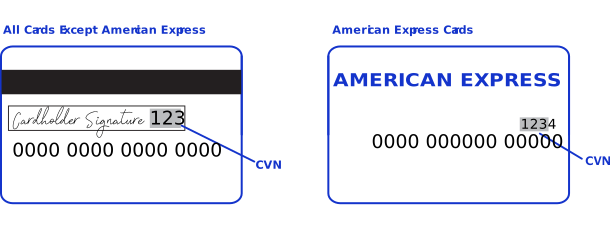
Each payment card company has its own name for the CVN value:
- Mastercard calls it thecard validation code(CVC2).
- Visa calls it thecard verification value(CVV2).
International Transactions
Consider compliance and merchant remittance funding when processing international
transactions.
Compliance
Accepting payments from a country other than your own requires that you observe the
processing rules and practices of the payment systems in that country. This list describes
areas of compliance that are especially important:
- Merchant descriptor requirements—A merchant descriptor communicates merchant information to customers to remind them of the circumstances that triggered a payment. Merchant descriptors reduce the possibility of a chargeback. Accordingly, the merchant descriptor displayed on a customer’s statement should be a close match to the name on your website. It is not good practice to consolidate multiple websites into a single merchant account and use a generic descriptor that more-or-less covers all offerings.
- Excessive chargebacks—To prevent an excessive number of chargebacks, you must maintain good customer support, rapid problem resolution, a high level of customer satisfaction, and transaction management processes that minimize fraudulent transactions. When payment card chargebacks become excessive, you must change business processes to reduce chargebacks. If chargebacks are not reduced to a satisfactory level, your account can be terminated.
Merchant Remittance Funding
You can request that the transaction proceeds be converted to another currency. Currency
conversion uses a foreign exchange rate to calculate the conversion to the requested currency.
The foreign exchange rate might be explicitly stated as a rate or implicitly stated as a
transaction amount. The funded amount and can vary from day to day. The foreign exchange rate
might also include an increase for the foreign exchange risk, sales commissions, and handling
costs.
Payment Services
Various services are involved in processing payments.
These services enable customers to purchase goods and services. They also enable merchants to
receive payments from customer accounts, to provide refunds, and to void transactions.
Authorization
An authorization confirms that a payment card account holds enough funds to pay
for a purchase. Authorizations can be made online or offline.
Micropayment Authorization
Micropayments are payments for less than one unit in the transaction’s currency.
Cybersource
does not support micropayment authorizations for UATP
.Online Authorization
Online authorizations provide immediate confirmation of funds availability. The customer's
financial institution also reduces the amount of credit available in the customer's account,
setting aside the authorized funds for the merchant to capture at a later time. Authorizations
for most payment cards are processed online. Typically, it is safe to start fulfilling the
order when you receive an authorization confirmation.
An
An online authorization confirmation
and the subsequent hold on funds expire after a specific length of time. Therefore it is
important to capture funds in a timely manner. The issuing bank sets the expiration time
interval, but most authorizations expire within 5 to
7 days.The issuing bank does not inform
Cybersource
when an authorization
confirmation expires. By default, the authorization information for each transaction remains
in the Cybersource
database for 180 days after the authorization date. To
capture an authorization that expired with the issuing bank, you can resubmit the
authorization request.Offline Authorization
Online transactions require an internet connection. In situations where the internet is not
available, for example, due to an outage, merchants can continue to take credit card payments
using offline transactions. An offline authorization is an authorization request for which you
do not receive an immediate confirmation about the availability of funds.
Offline authorizations have a higher level of risk than online transactions because they do
not confirm funds availability or set aside the funds for later capture. Further, it can take
up to 5 days to receive payment confirmations for offline transactions. To mitigate this risk,
merchants may choose to fulfill orders only after receiving payment confirmation.
Authorization Workflow
This image and description show the authorization workflow:

- The customer purchases goods or services from the merchant using a payment card.
- You send an authorization request over secure internet connection toCybersource. When the customer buys a digitally delivered product or service, you can request both the authorization and the capture at the same time. When the customer buys a physically fulfilled product, do not request the capture until you ship the product.
- Cybersourcevalidates the order information then contacts your payment processor and requests authorization.
- The processor sends the transaction to the payment card company, which routes it to the issuing bank for the customer's payment card. Some card companies, including Discoverand American Express, act as their own issuing banks.
- The issuing bank approves or declines the request.
- If funds are available, the issuing bank reserves the amount of the authorization request and returns an authorization approval toCybersource.
- If the issuing bank denies the request, it returns an authorization denial toCybersource.
- Cybersourceruns its own tests then tells you whether the authorization succeeded.
Sale
A sale is a bundled authorization and capture. Some processors and acquirers require a sale
transaction instead of using separate authorization and capture requests. For other processors
and acquirers, you can request a sale instead of a separate authorization and capture when you
provide the goods or services immediately after taking an order.
There are two types of sale processing: dual-message processing and single-message
processing.
Dual-Message Processing
Dual-message processing is a two-step process. The authorization is processed first. If the
authorization is successful, the capture is processed immediately afterward. The response
includes the authorization and the capture information. If the authorization is declined, the
capture is not processed, and the response message includes only the authorization
information.
Capture
A capture is a follow-on transaction to an authorization. It is used to transfer the
authorized funds from the customer's account to the merchant account. To link the
authorization transaction to the capture transaction, you include a request ID in your capture
request. This request ID is returned to you in the authorization response.
Captures are typically not performed in real time. They are placed in a batch file and sent
to the processor, and the processor settles all of the captures at one time. In most cases,
these batch files are sent and processed outside of the merchant's business hours. It usually
takes 2 to 4 days for the acquiring financial institution to deposit the funds into the
merchant account.
When fulfilling only part of a customer’s order, do not capture the full amount of the authorization. Capture only the cost of the delivered items. When you deliver the remaining items, request a new authorization, and then capture the new authorization.
IMPORTANT
It is not possible to perform a capture if a transaction is in a review state, which can
occur if you use a fraud management service. You must accept the transaction prior to capture.
For more information, see the fraud management documentation in
the
Business Center
.Capture Workflow
The capture workflow begins when you send a request for a capture.
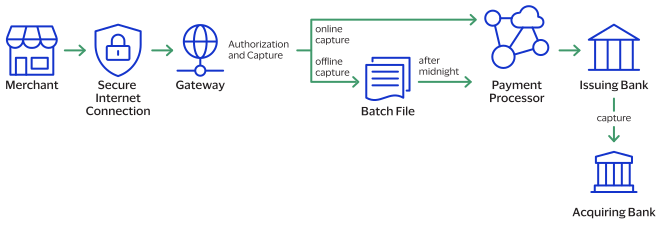
- The merchant sends a request for a capture to theCybersourcegateway.
- For online captures,Cybersourcevalidates the order information then sends an online capture to the payment processor.For offline captures,Cybersourcestores the capture request in a batch file and sends the batch file to the payment processor after midnight.
- The processor validates the request and forwards it to the issuing bank.
- The issuing bank transfers funds to the acquiring bank.
IMPORTANT
The payment processor does not notify
Cybersource
that the money has been transferred. To ensure that all captures are
processed correctly, you should reconcile your capture requests with the capture reports from
your processor.Refund
Refund
Refunds are payment refunds from a merchant to the cardholder after a
cardholder pays for a product or service and that payment is captured by the merchant. When a
refund request is successful, the issuer transfers funds from the merchant bank (acquirer)
account to the customer's account. It typically takes 2 to 4 days for the acquirer to transfer
funds from your merchant account.
There are two types of refunds: a
follow-on refund
that is linked to
an original capture or sale, and a stand-alone credit
that is not linked to an original
capture or sale.WARNING
You should carefully control access to your
refund and
credit services. Do not request
this service directly from your customer interface. Instead, incorporate this service as part
of your customer service process. This process reduces the potential for fraudulent
transactions.Follow-on Refund
Follow-on Refund
Refunds, also known as
use the capture
request ID to link the refund to the original transaction. follow-on refunds
,This request ID is returned during the capture request (also known as a
The request ID links the transaction to the customer’s billing and account
information, so you are not required to include those fields in the settlement
) and is used in all subsequent refunds associated with the original
capture.refund
request.When you combine a request for a
refund
with a request for another service, such as the tax calculation service, you
must provide the customer’s billing and account information.Unless otherwise specified,
refunds
must be requested within 180 days of a settlement. You can request multiple
follow-on refunds
against a single
capture or sale transaction as long as the total amount does not exceed the original
purchase amount. To perform multiple follow-on refunds
, use the same request ID in each request.Stand-Alone Credits
Stand-alone credits are not connected to an original transaction. Stand-alone credits do
not have a time restriction, and they can be used to issue refunds more than 180 days after
a transaction settlement.
Refund and Credit Workflow
This workflow applies to follow-on credits, also known as refunds, and stand-alone credits.
It begins when you send a request for a refund or credit.
Refunds and credits do not happen in real time. All of the credit requests for a day are
typically placed in a file and sent to the processor as a single
batch
transaction. In
most cases, the batch transaction is settled overnight.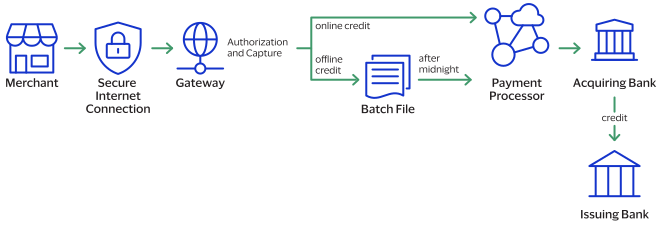
- The merchant sends the refund or credit request toCybersource.
- For online refunds and credits,Cybersourcevalidates the order information then sends the request to the payment processor.For offline refunds and credits,Cybersourcestores the request in a batch file and sends the batch file to the payment processor after midnight.
- The processor validates the request and forwards it to the acquiring bank.
- The acquiring bank transfers funds to the issuing bank.
IMPORTANT
Not all processors support stand-alone credits.
Void
A void cancels a capture or credit request that you submitted to
Cybersource
but has not already been submitted to your processor. Capture and credit requests are usually
submitted to your processor once a day, so your window for successfully voiding a capture or
credit request is small. A void request is declined when the capture or credit request has
already been sent to the processor.After a void is processed, you cannot credit or capture the funds. You must perform a new
transaction to capture or credit the funds. Further, when you void a capture, a hold remains
on the authorized funds. If you are not going to re-capture the authorization,
and if your processor supports authorization reversal after void
(ARAV),
you should request an authorization reversal to release the hold on the unused
funds.A void uses the capture or credit request ID to link the transactions. The authorization
request ID is used to look up the customer’s billing and account information, so there is no
need to include those fields in the void request. You cannot perform a follow-on credit
against a capture that has been voided.
Testing the Payment Services
To ensure that requests are processed correctly, you must test the basic success and error
conditions for each service you plan to use.
Requirements for Testing
Before you can test, contact customer support to activate the credit
card services and configure your account for testing. You must also contact your processor
to set up your processor account.
IMPORTANT
When building your connection to the
Cybersource
payment gateway, ensure that you have implemented controls to prevent card testing or card
enumeration attacks on your platform. For more information, see the best practices guide.
When we detect suspicious
transaction activity associated with your merchant ID, including a card testing or card
enumeration attack, Cybersource
reserves the right to enable fraud
management tools on your behalf in order to mitigate the attack. The fraud team might also
implement internal controls to mitigate attack activity. These controls block traffic that
is perceived as fraudulent. Additionally, if you are using one of our fraud tools and
experience a significant attack, our internal team might modify or add rules to your
configuration to help prevent the attack and minimize the threat to our infrastructure.
However, any actions taken by Cybersource
would not replace the need for you
to follow industry standard best practices to protect your systems, servers, and
platforms.Follow these requirements when you test your system:
- Use your regular merchant ID.
- Use a real combination for the city, state, and postal code.
- Use a real combination for the area code and telephone number.
- Use a nonexistent account and domain name for the customer’s email address.
- REST API test endpoint:POSThttps://apitest.cybersource.com/pts/v2/payments
Test Card Numbers
Use these payment card numbers to test the authorization, capture, and credit services.
Remove the spaces from the test card numbers when sending them to the test system. Do not use
real payment card numbers. To test card types that are not included in the list, use an
account number that is in the card’s BIN range. For best results, try each test with a
different service request and with different test payment card numbers.
IMPORTANT
The test card numbers that are provided are
formatted with Xs for zeroes in the card number. When testing with these card numbers, remove the spaces and replace each X with a 0 (zero).
- American Express—3782 8224 631X XX5
- Discover—6X11 1111 1111 1117
- JCB—3566 1111 1111 1113
- Maestro (International)
- 5X33 9619 89X9 17
- 5868 2416 0825 5333 38
- Maestro (UK Domestic)—the issue number is not required for Maestro (UK Domestic) transactions.
- 6759 4111 XXXX XXX8
- 6759 56XX 45XX 5727 054
- 5641 8211 1116 6669
- Mastercard
- 2222 42XX XXXX 1113
- 2222 63XX XXXX 1125
- 5555 5555 5555 4444
- UATP (CVV not required)
- 1354 1234 5678 911
- 1485 1234 5678 9X5
- Visa—4111 1111 1111 1111
Using Amounts to Simulate Errors
You can simulate error messages by requesting authorization, capture, or credit services with specific amounts that trigger the error messages. These triggers work only on the test server, not on the production server.
Each payment processor uses its own error messages.
For more
information, see:
REST API Testing Guide
Test American Express Card Verification
Before using CVN with American Express, it is strongly recommended that you follow these
steps:
- Contact customer support to have your account configured for CVN. Until you do this, you will receive a1in theprocessorInformation.cardVerification.resultCoderesponse field.
- Test your system in production using a small currency amount, such as one currency unit. Instead of using the test account numbers, use a real payment card account number, and send an incorrect CVN in the request for authorization. The card should be refused and the request declined.
Standard Payment Processing
This section shows you how to process various authorization, capture, credit, and sales
transactions.
Basic Authorization
This section provides the information you need in order to process a basic
authorization.
All supported card types can process authorizations.
Endpoint
Production:
POST
https://api.cybersource.com
/pts/v2/paymentsTest:
POST
https://apitest.cybersource.com
/pts/v2/paymentsDeclined Authorization
If an authorization is declined, you can use response categories to help you decide whether
to retry or block a declined transaction. These response fields provide additional
information:
- paymentInsightsInformation.responseInsights.category
- paymentInsightsInformation.responseInsights.categoryCode
Category codes have possible values (such as
01
) each of which corresponds to a
category that contains a description. You cannot retry this category code and category:
- 01 ISSUER_WILL_NEVER_APPROVE
- 02 ISSUER_CANNOT_APPROVE_AT_THIS_TIME
- 03 ISSUER_CANNOT_APPROVE_WITH_THESE_DETAILS: Data quality issue. Revalidate data prior to retrying the transaction.
- 04 GENERIC_ERROR
- 97 PAYMENT_INSIGHTS_INTERNAL_ERROR
- 98 OTHERS
- 99 PAYMENT_INSIGHTS_RESPONSE_CATEGORY_MATCH_NOT_FOUND
Required Fields for Processing a Basic Authorization
REST Example: Processing a Basic Authorization
Request
{
    "orderInformation": {
        "billTo": {
            "country": "US",
            "lastName": "Kim",
            "address1": "201 S. Division St.",
            "postalCode": "48104-2201",
            "locality": "Ann Arbor",
            "administrativeArea": "MI",
            "firstName": "Kyong-Jin",
            "email": "test@cybs.com"
        },
        "amountDetails": {
            "totalAmount": "100.00",
            "currency": "usd"
        }
    },
    "paymentInformation": {
        "card": {
            "expirationYear": "2031",
            "number": "4111111111111111",
            "expirationMonth": "12",
            "type": "001"
        }
    }
}
Response to a Successful Request
{
  "_links" : {
    "authReversal" : {
      "method" : "POST",
      "href" : "/pts/v2/payments/6461731521426399003473/reversals"
    },
    "self" : {
      "method" : "GET",
      "href" : "/pts/v2/payments/6461731521426399003473"
    },
    "capture" : {
      "method" : "POST",
      "href" : "/pts/v2/payments/6461731521426399003473/captures"
    }
  },
  "clientReferenceInformation" : {
    "code" : "1646173152047"
  },
  "id" : "6461731521426399003473",
  "orderInformation" : {
    "amountDetails" : {
      "authorizedAmount" : "100.00",
      "currency" : "usd"
    }
  },
  "paymentAccountInformation" : {
    "card" : {
      "type" : "001"
    }
  },
  "paymentInformation" : {
    "tokenizedCard" : {
      "type" : "001"
    },
    "card" : {
      "type" : "001"
    }
  },
 "paymentInsightsInformation" : {
    "responseInsights" : {
      "categoryCode" : "01"
    }
  },
  "processorInformation" : {
    "systemTraceAuditNumber" : "862481",
    "approvalCode" : "831000",
    "merchantAdvice" : {
      "code" : "01",
      "codeRaw" : "M001"
    },
    "responseDetails" : "ABC",
    "networkTransactionId" : "016153570198200",
    "consumerAuthenticationResponse" : {
      "code" : "2",
      "codeRaw" : "2"
    },
    "transactionId" : "016153570198200",
    "responseCode" : "00",
    "avs" : {
      "code" : "Y",
      "codeRaw" : "Y"
    }
  },
  "reconciliationId" : "6461731521426399003473",
  "status" : "AUTHORIZED",
  "submitTimeUtc" : "2022-03-01T22:19:12Z"
}
Response to a Declined Request
{ "clientReferenceInformation": { "code": "TC50171_3" }, "errorInformation": { "reason": "PROCESSOR_ERROR", "message": "Invalid account" }, "id": "6583553837826789303954","paymentInsightsInformation": { "responseInsights": { "categoryCode": "01", "category": "ISSUER_WILL_NEVER_APPROVE" } },"pointOfSaleInformation": { "amexCapnData": "1009S0600100" }, "processorInformation": { "systemTraceAuditNumber": "004544", "merchantNumber": "1231231222", "networkTransactionId": "431736869536459", "transactionId": "431736869536459", "responseCode": "111", "avs": { "code": "Y", "codeRaw": "Y" } }, "status": "DECLINED" }
Authorization with Line Items
This section shows you how to process an authorization with line items.
The main difference between a basic authorization and an authorization that includes
line items is that the
orderInformation.amountDetails.totalAmount
field, which is included in a basic
authorization, is substituted with one or more line items that are included in a
.lineItem[]
arrayFields Specific to this Use Case
These
fields
are required for each line item that you use:- orderInformation.lineItems[].unitPrice
- orderInformation.lineItems[].quantity
- orderInformation.lineItems[].productCode
- orderInformation.lineItems[].productSku
- Optional whenitem_#_productCodeis set todefault,shipping_only,handling_only, orshipping_and_handling
- orderInformation.lineItems[].productName
- Optional whenitem_#_productCodeis set todefault,shipping_only,handling_only, orshipping_and_handling
At a minimum, you must include the
orderInformation.lineItems[].unitPrice
field in order to include a line
item in an authorization. When this field is the only field included in the
authorization, the system sets:- orderInformation.lineItems[].productCode:default
- orderInformation.lineItems[].quantity:1
For example, these three line items are valid.
"orderInformation": {
  "lineItems": [
    {
      "unitPrice": "10.00"
    },
    {
      "unitPrice": "5.99",
      "quantity": "3",
      "productCode": "shipping_only"
    },
    {
      "unitPrice": "29.99",
      "quantity": "3",
      "productCode": "electronic_good",
      "productSku": "12384569",
      "productName": "receiver"
    }
  ]
}
Endpoint
Production:
POST
https://api.cybersource.com
/pts/v2/paymentsTest:
POST
https://apitest.cybersource.com
/pts/v2/paymentsRequired Fields for Processing an Authorization with Line Items
REST Example: Processing an Authorization with Line
Items
Request
{
  "currencyConversion": {
    "indicator": "Y"
  },
  "paymentInformation": {
    "card": {
      "number": "4111111111111111",
      "expirationMonth": "12",
      "expirationYear": "2031"
    }
  },
  "orderInformation": {
    "amountDetails": {
      "currency": "USD",
      "exchangeRate": ".91",
      "originalAmount": "107.33",
      "originalCurrency": "eur"
    },
    "billTo": {
      "firstName": "John",
      "lastName": "Doe",
      "address1": "1 Market St",
      "locality": "san francisco",
      "administrativeArea": "CA",
      "postalCode": "94105",
      "country": "US",
      "email": "test@cybs.com"
    },
    "lineItems": [
      {
        "unitPrice": "10.00"
      },
      {
        "unitPrice": "5.99",
        "quantity": "3",
        "productCode": "shipping_only"
      },
      {
        "unitPrice": "29.99",
        "quantity": "3",
        "productCode": "electronic_good",
        "productSku": "12384569",
        "productName": "receiver"
      }
    ]
  }
}
Response to a Successful Request
{
  "_links": {
    "authReversal": {
      "method": "POST",
      "href": "/pts/v2/payments/6482385519226028804003/reversals"
    },
    "self": {
      "method": "GET",
      "href": "/pts/v2/payments/6482385519226028804003"
    },
    "capture": {
      "method": "POST",
      "href": "/pts/v2/payments/6482385519226028804003/captures"
    }
  },
  "clientReferenceInformation": {
    "code": "1648238551902"
  },
  "id": "6482385519226028804003",
  "orderInformation": {
    "amountDetails": {
      "authorizedAmount": "117.94",
      "currency": "USD"
    }
  },
  "paymentAccountInformation": {
    "card": {
      "type": "001"
    }
  },
  "paymentInformation": {
    "tokenizedCard": {
      "type": "001"
    },
    "card": {
      "type": "001"
    }
  },
  "processorInformation": {
    "systemTraceAuditNumber": "191521",
    "approvalCode": "831000",
    "merchantAdvice": {
      "code": "01",
      "codeRaw": "M001"
    },
    "responseDetails": "ABC",
    "networkTransactionId": "016153570198200",
    "consumerAuthenticationResponse": {
      "code": "2",
      "codeRaw": "2"
    },
    "transactionId": "016153570198200",
    "responseCode": "00",
    "avs": {
      "code": "Y",
      "codeRaw": "Y"
    }
  },
  "reconciliationId": "6482385519226028804003",
  "status": "AUTHORIZED",
  "submitTimeUtc": "2022-03-25T20:02:32Z"
}
Sale
This section provides the information you need in order to process a sale
transaction.
A sale combines an authorization and a capture into a single transaction.
Endpoint
Production:
POST
https://api.cybersource.com
/pts/v2/paymentsTest:
POST
https://apitest.cybersource.com
/pts/v2/paymentsRequired Fields for a Sale
- Set the value totrue.
REST Example: Sale
Request
{
  "processingInformation": {
    "capture": true
  },
  "orderInformation" : {
    "billTo" : {
    "country" : "US",
    "lastName" : "VDP",
    "address1" : "201 S. Division St.",
    "postalCode" : "48104-2201",
    "locality" : "Ann Arbor",
    "administrativeArea" : "MI",
    "firstName" : "RTS",
    "email" : "test@cybs.com"
  },
    "amountDetails" : {
      "totalAmount" : "100.00",
      "currency" : "usd"
     }
   },
  "paymentInformation" : {
    "card" : {
      "expirationYear" : "2031",
      "number" : "4111111111111111",
      "expirationMonth" : "12",
      "type" : "001
    }
  }
}
Response to a Successful Request
Most processors do not return all of the fields that are shown in this
example.
{
  "_links" : {
    "void" : {
      "method" : "POST",
      "href" : "/pts/v2/payments/6485004068966546103093/voids"
    },
    "self" : {
      "method" : "GET",
      "href" : "/pts/v2/payments/6485004068966546103093"
    }
  },
  "clientReferenceInformation" : {
    "code" : "RTS-Auth"
  },
  "id" : "6485004068966546103093",
  "orderInformation" : {
    "amountDetails" : {
      "totalAmount" : "100.00",
      "authorizedAmount" : "100.00",
      "currency" : "usd"
    }
  },
  "paymentAccountInformation" : {
    "card" : {
      "type" : "001"
    }
  },
  "paymentInformation" : {
    "tokenizedCard" : {
      "type" : "001"
    },
    "card" : {
      "type" : "001"
    }
  },
  "processorInformation" : {
    "systemTraceAuditNumber" : "841109",
    "approvalCode" : "831000",
    "merchantAdvice" : {
      "code" : "01",
      "codeRaw" : "M001"
    },
    "responseDetails" : "ABC",
    "networkTransactionId" : "016153570198200",
    "retrievalReferenceNumber" : "208720841109",
    "consumerAuthenticationResponse" : {
      "code" : "2",
      "codeRaw" : "2"
    },
    "transactionId" : "016153570198200",
    "responseCode" : "00",
    "avs" : {
      "code" : "Y",
      "codeRaw" : "Y"
    }
  },
  "reconciliationId" : "6485004068966546103093",
  "status" : "AUTHORIZED",
  "submitTimeUtc" : "2022-03-28T20:46:47Z"
}
Capture
This section describes how to capture an authorized transaction.
Endpoint
Production:
POST
https://api.cybersource.com
/pts/v2/payments/{id}
/capturesTest:
POST
https://apitest.cybersource.com
/pts/v2/payments/{id}
/capturesThe is the transaction ID
returned in the authorization response.
{id}
Required Fields for Capturing an Authorization
- This field value maps from the original authorization, sale, or credit transaction.
REST Example: Capturing an Authorization
Request
{
    "clientReferenceInformation": {
        "code": "ABC123"
    },
    "orderInformation": {
        "amountDetails": {
            "totalAmount": "100.00",
            "currency": "EUR"
    }
}
Response to a Successful Request
{
    "_links": {
        "void": {
            "method": "POST",
            "href": "/pts/v2/captures/6662994431376681303954/voids"
        },
        "self": {
            "method": "GET",
            "href": "/pts/v2/captures/6662994431376681303954"
        }
    },
    "clientReferenceInformation": {
        "code": "1666299443215"
    },
    "id": "6662994431376681303954",
    "orderInformation": {
        "amountDetails": {
            "totalAmount": "100.00",
            "currency": "EUR"
        }
    },
    "reconciliationId": "66535942B9CGT52U",
    "status": "PENDING",
    "submitTimeUtc": "2022-10-20T20:57:23Z"
}
Follow-On Refund
Refund
This section provides the information you need in order to process a follow-on
refund
, which is linked to a capture or sale. You must request a follow-on refund
within 180 days of the authorization or sale.Endpoint
Production:
POST
https://api.cybersource.com
/pts/v2/payments/{id}
/refundsTest:
POST
https://apitest.cybersource.com
/pts/v2/payments/{id}
/refundsThe is the transaction ID
returned in the capture or sale response.
{id}
Required Fields for Processing a Refund
Refund
REST Example: Processing a Refund
Request
{
    "orderInformation": {
        "amountDetails": {
            "totalAmount": "100.00",
            "currency": "EUR"
        }
    }
}
Response to a Successful Request
{
    "_links": {
        "void": {
            "method": "POST",
            "href": "/pts/v2/credits/6699964581696622603955/voids"
        },
        "self": {
            "method": "GET",
            "href": "/pts/v2/credits/6699964581696622603955"
        }
    },
    "clientReferenceInformation": {
        "code": "1669996458298"
    },
    "creditAmountDetails": {
        "currency": "eur",
        "creditAmount": "100.00"
    },
    "id": "6699964581696622603955",
    "orderInformation": {
        "amountDetails": {
            "currency": "EUR"
        }
    },
    "paymentAccountInformation": {
        "card": {
            "type": "001"
        }
    },
    "paymentInformation": {
        "tokenizedCard": {
            "type": "001"
        },
        "card": {
            "type": "001"
        }
    },
    "processorInformation": {
        "approvalCode": "888888",
        "networkTransactionId": "016153570198200",
        "responseCode": "100"
    },
    "reconciliationId": "61873329OAILG3Q6",
    "status": "PENDING",
    "submitTimeUtc": "2022-12-02T15:54:18Z"
}
Stand-Alone Credit
This section shows you how to process a credit, which
is not linked to a capture or sale. There is no time limit for requesting a credit.
Endpoint
Production:
POST
https://api.cybersource.com
/pts/v2/credits/Test:
POST
https://apitest.cybersource.com
/pts/v2/credits/Required Fields for Processing a Credit
REST Example: Processing a Stand-Alone Credit
Request
{
  "orderInformation" : {
    "billTo" : {
      "country" : "US",
      "lastName" : "Kim",
      "address1" : "201 S. Division St.",
      "postalCode" : "48104-2201",
      "locality" : "Ann Arbor",
      "administrativeArea" : "MI",
      "firstName" : "Kyong-Jin",
      "email" : "test@cybs.com"
    },
    "amountDetails" : {
      "totalAmount" : "100.00",
      "currency" : "eur"
    }
  },
  "paymentInformation" : {
    "card" : {
      "expirationYear" : "2031",
      "number" : "4111111111111111",
      "expirationMonth" : "12"
    }
  }
}
Response to a Successful Request
{
    "_links": {
        "void": {
            "method": "POST",
            "href": "/pts/v2/credits/6663069906146706403954/voids"
        },
        "self": {
            "method": "GET",
            "href": "/pts/v2/credits/6663069906146706403954"
        }
    },
    "clientReferenceInformation": {
        "code": "1666306990717"
    },
    "creditAmountDetails": {
        "currency": "eur",
        "creditAmount": "100.00"
    },
    "id": "6663069906146706403954",
    "orderInformation": {
        "amountDetails": {
            "currency": "eur"
        }
    },
    "paymentAccountInformation": {
        "card": {
            "type": "001"
        }
    },
    "paymentInformation": {
        "tokenizedCard": {
            "type": "001"
        },
        "card": {
            "type": "001"
        }
    },
    "processorInformation": {
        "approvalCode": "888888",
        "networkTransactionId": "016153570198200",
        "responseCode": "100"
    },
    "reconciliationId": "66490108K9CLFJPN",
    "status": "PENDING",
    "submitTimeUtc": "2022-10-20T23:03:10Z"
}
Void a Payment
This section describes how to void a payment that was submitted but not yet processed by the
processor. A payment is also known as a sale, which is an authorization and capture in one API
request. Include the payment ID in the void request endpoint to cancel the payment.
Required Fields for Voiding a Payment
REST Example: Voiding a Payment
Request
{
    "clientReferenceInformation": {
        "code": "123456789012"
    }
}
Response to a Successful Request
{
    "submitTimeUtc": "2025-03-11T16:39:30Z",
    "processorInformation": {
        "approvalCode": "OK1272",
        "responseCode": "000"
    },
    "consumerAuthenticationResponse": {
        "systemTraceAuditNumber": "500036"
    },
    "orderInformation": {
        "amountDetails": {
            "authorizedAmount": "110.00"
        }
    },
    "message": "Successful transaction.",
    "clientReferenceInformation": {
        "code": "123456789012"
    },
    "reconciliationId": "000000050000771",
    "id": "7417111702443232235535",
    "_links": {
        "self": {
            "method": "GET",
            "href": "/pts/v2/voids/7417111702443232235535"
        }
    },
    "status": "VOIDED"
}
Void for a Capture or Credit
This section describes how to void a capture or credit that was submitted but not yet
processed by the processor.
Endpoints
Void a Capture
Production:
POST
https://api.cybersource.com
/pts/v2/captures/{id}
/voidsTest:
POST
https://apitest.cybersource.com
/pts/v2/captures/{id}
/voidsVoid a Credit
Production:
POST
https://api.cybersource.com
/pts/v2/credits/{id}
/voidsTest:
POST
https://apitest.cybersource.com
/pts/v2/credits/{id}
/voidsThe is the transaction ID returned during the
credit response.
{id}
Required Fields for Voiding a Capture or Credit
- Including this field is recommended, but not required.
REST Example: Voiding a Capture or Credit
Request
{
    "clientReferenceInformation": {
        "code": "test123"
    }
}
Response to a Successful Request
{
    "_links": {
        "self": {
            "method": "GET",
            "href": "/pts/v2/voids/6541933390746728203005"
        }
    },
    "clientReferenceInformation": {
        "code": "1654193339056"
    },
    "id": "6541933390746728203005",
    "orderInformation": {
        "amountDetails": {
        "currency": "USD"
        }
    },
    "status": "VOIDED",
    "submitTimeUtc": "2022-06-02T18:08:59Z",
    "voidAmountDetails": {
        "currency": "usd",
        "voidAmount": "100.00"
    }
}