On This Page
Introduction to REST
To get started using
Cybersource
APIs, you must first set up
your system to be REST-compliant. Cybersource
uses REST for developing
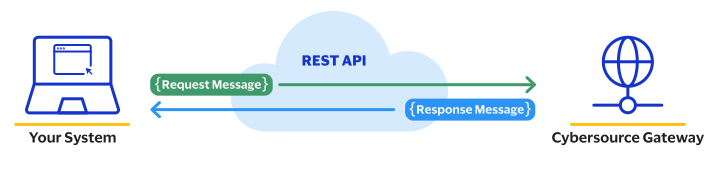
web services. REST enables your system to exchange request and response messages with
the Cybersource
gateway using HTTP. This guide explains how to set up
secure messaging using JSON Web Tokens
or HTTP Signature Security
.
- JSON Web Token Messaging
- JSON Web Tokens (JWTs) are digitally signed JSON objects based on the open standard RFC 7519. These tokens provide a compact, self-contained method for securely transmitting information between parties. Depending on your integration, you can sign your tokens with a certificate private key or a shared secret key. The signature is calculated from the JWS header and payload, which enables the receiver to verify that the content has not been tampered with.WARNINGAs ofFebruary 2026, there are new requirements for constructing JWTs. This update also requires you to encrypt and decrypt messages using Message-Level Encryption (MLE). To remain compliant, you must update how your system constructs JWTs with MLE byMarch 2027. If you do not update your system before the March deadline, you risk transaction failure. Use this guide to update your system.
- HTTP Signature Security Messaging

- With HTTP Signature messaging, each request is digitally signed using a shared secret. This enables both the client and the server to validate the authenticity and integrity of the request. If a request is intercepted during transmission, an attacker cannot modify it or impersonate the sender without the shared secret key. HTTP Signature messaging can be used only with API requests and cannot be used in browser-based or mobile applications.WARNINGByMarch 2027, all merchants using HTTP signature messaging must migrate to JSON Web Token (JWT) messaging in order to support message-level encryption (MLE). You risk transaction failures if you do not implement this update. If you are setting up your system to be REST-compliant for the first time,Cybersourcerecommends using JWT messaging.
 Fraud Prevention and Security Responsibilities
Fraud Prevention and Security ResponsibilitiesWhen setting up your connection to the
Cybersource
gateway, verify
that you have implemented controls to prevent card testing and card enumeration
attacks on your platform. For more information, see the best practices guide.
If
Cybersource
detects suspicious transaction activity associated
with your merchant ID, including card testing or card enumeration attacks, Cybersource
reserves the right to enable fraud management tools on your
behalf to help mitigate the attack. The fraud team might also implement internal
controls that block traffic perceived as fraudulent.If you are already using a
Cybersource
fraud tool and experience a
significant attack, Cybersource
internal teams might modify or add
rules to your configuration to help reduce the threat to both your business and
Cybersource
infrastructure. However, these actions do not
replace your responsibility to follow industry-standard best practices to protect
your systems, servers, and platforms.