On This Page
Credit
Credit
Credits are payment refunds from a merchant to the cardholder after a cardholder pays for a
product or service and that payment is captured by the merchant. When a credit request is
successful, the issuer transfers funds from the merchant bank (acquirer) account to the
customer's account. It typically takes 2 to 4 days for the acquirer to transfer funds from
your merchant account.
There are two types of credits: a
follow-on credit
that is linked to an
original capture or sale, and a stand-alone credit
that is not linked to an original
capture or sale.Follow-on
Credit
Follow-on
Credit
Follow-on credits, also known as
use the capture
request ID to link the refund to the original transaction. refunds
,This request ID is returned during the capture request (also known as a
The request ID links the transaction to the customer’s billing and account
information, so you are not required to include those fields in the settlement
) and is used in all subsequent refunds associated with the original
capture.follow-on credit
request.When you combine a request for a
follow-on
credit
with a request for another service, such as the tax calculation service, you
must provide the customer’s billing and account information.Unless otherwise specified,
follow-on
credits
must be requested within 180 days of a settlement. You can request multiple
follow-on credits
against a single
capture or sale transaction as long as the total amount does not exceed the original
purchase amount. To perform multiple follow-on credits
, use the same request ID in each request.Stand-Alone Credits
Stand-alone credits are not connected to an original transaction. Stand-alone credits do
not have a time restriction, and they can be used to issue refunds more than 180 days after
a transaction settlement.
Refund and Credit Workflow
This workflow applies to follow-on credits, also known as refunds, and stand-alone credits.
It begins when you send a request for a refund or credit.
Refunds and credits do not happen in real time. All of the credit requests for a day are
typically placed in a file and sent to the processor as a single
batch
transaction. In
most cases, the batch transaction is settled overnight.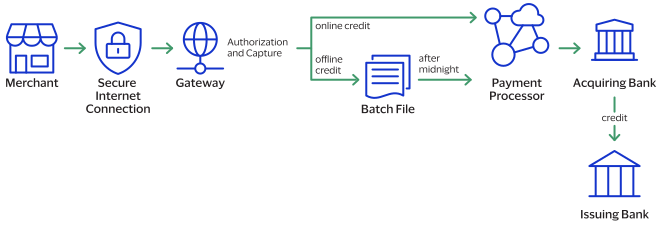
- The merchant sends the refund or credit request toCybersource.
- For online refunds and credits,Cybersourcevalidates the order information then sends the request to the payment processor.For offline refunds and credits,Cybersourcestores the request in a batch file and sends the batch file to the payment processor after midnight.
- The processor validates the request and forwards it to the acquiring bank.
- The acquiring bank transfers funds to the issuing bank.
Not all processors support stand-alone credits.