On This Page
Flexible Transaction Scenario
The Flexible transaction scenario for EV charging enables an efficient and customer- and
merchant-friendly solution for EV charging transactions. The transaction amount is
calculated based on the amount of time or number of kilowatts (kW) used during the EV
charging session. This transaction scenario has implementation prerequisites. For more
information, see Prerequisites for the Flexible Transaction Scenario.
The Flexible transaction scenario offers these features and benefits:
- Real time adjustments to the EV charging session cost. For more information about this key feature, see the description ofdynamic adjustment capabilitybelow.
- Accommodation of variations in charging time and energy consumption.
- Customers benefit from more accurate billing based on actual usage.
- Merchants benefit from receiving accurate payments for the energy provided and reduce the risk of unpaid balances or excessive refunds.
A key features of the Flexible transaction scenario is the
dynamic adjustment
capability
. When the EV charging session costs more than the initially estimated
amount, an incremental authorization request is sent to obtain the additional
transaction amount. A merchant can send multiple incremental authorization requests
during the charging sessions to increase the charging transaction amount. When the final
cost of the charging session, including incremental authorizations, is less than the
estimated amount, an automatic, host-generated partial reversal request is sent at the
time of capture.Figure:
Flexible Transaction Workflow
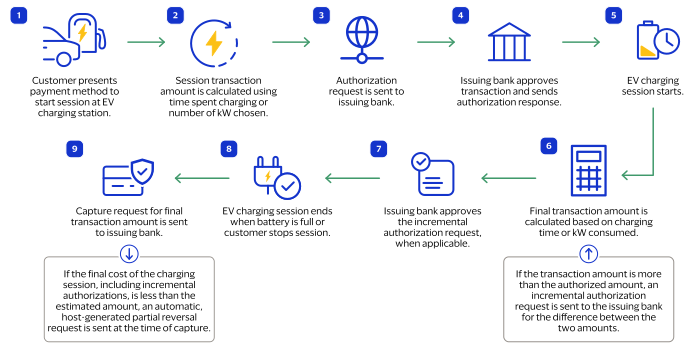
The Flexible transaction workflow for EV charging typically consists of this sequence of
events:
- The customer presents a payment method to start a charging session at an EV charging station.
- The charging session transaction amount is calculated using the amount of time spent charging or number of kW chosen.
- The authorization request is sent to the issuing bank.
- The issuing bank approves the transaction and sends an authorization response. A temporary hold for the authorized amount is placed on the customer's payment method.
- The EV charging session starts.
- The final transaction amount is calculated by the EV charging payment system based on the charging time or kW consumed. When the transaction amount is more than the initially authorized amount, an incremental authorization is sent to the issuing bank for the difference between the two amounts.
- The issuing bank approves incremental authorization request, when applies.
- The EV charging session ends when the battery is fully charged or when the customer manually stops the charging session.
- A capture request for the final transaction amount is sent to the issuing bank. When the final cost of the charging session, including any incremental authorizations, is less than the estimated amount, an automatic, host-generated partial reversal request is sent at the time of capture.
Prerequisites for the Flexible Transaction Scenario
To implement the Flexible transaction scenario for EV charging, your payment system must
have these prerequisite capabilities:
- Calculates initial estimated EV charging cost based on average charging duration and energy consumption.
- Monitors real time EV charging progress.
- Performs incremental authorizations.
- Communicates with payment systems to perform adjustments.